Mugwort
The Nine Herbs Charm's eldest, the traveler's amulet, the modern craft's dream herb — sourced, compared, untangled from the myths.
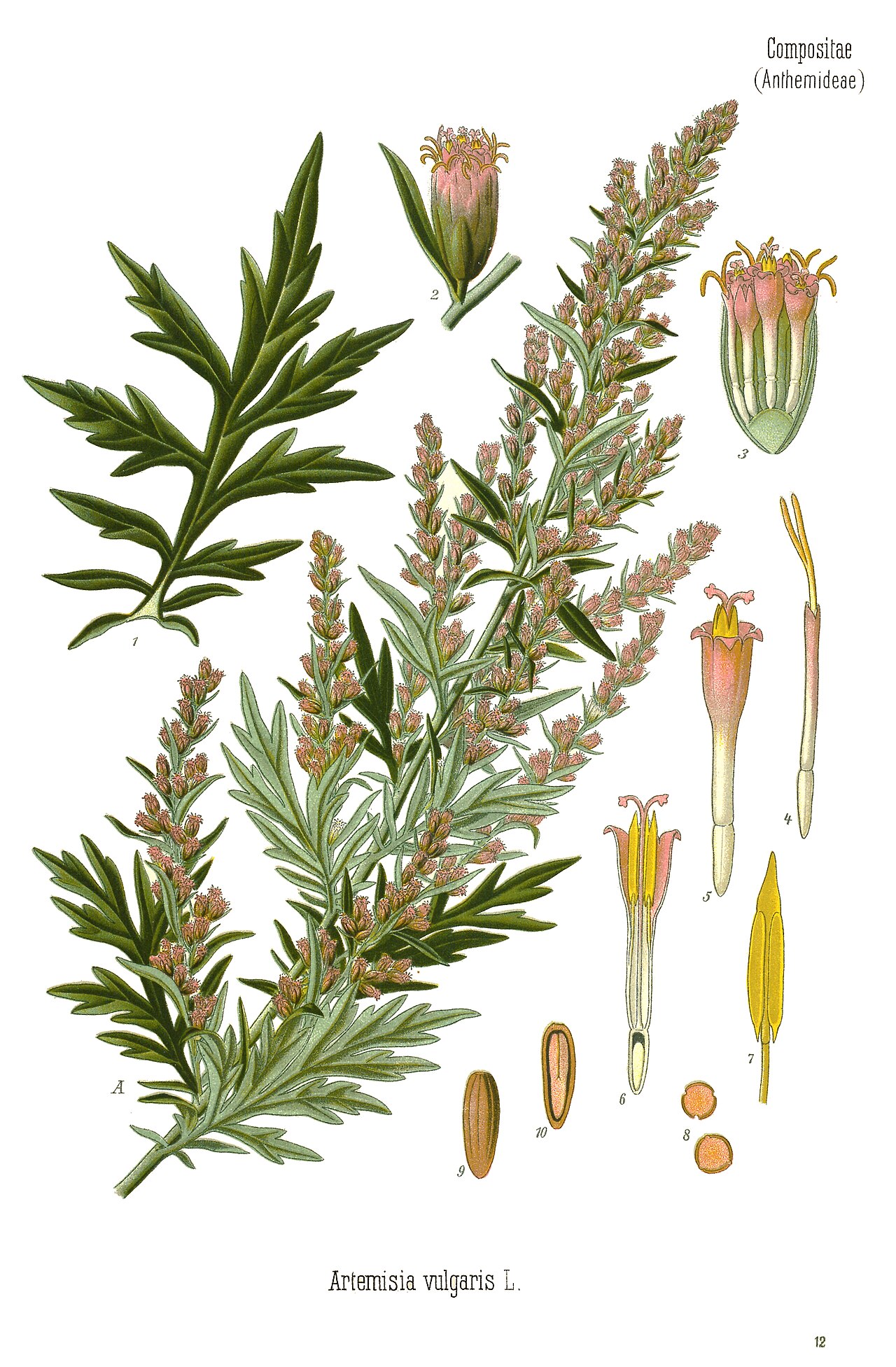
Mugwort (Artemisia vulgaris) is the herb modern witchcraft puts in dream pillows and the herb the Anglo-Saxons named first in the most famous charm in Old English. The two facts are usually presented as the same fact. They are not.
This page is an attempt to keep the herb’s lineage straight: where it actually appears in pre-modern sources, where it was reassigned by twentieth-century revival writers, and what a practitioner is honestly working with when they reach for it.
The herb
Artemisia vulgaris is a tall, ditch-loving member of the daisy family, silver-backed leaves, faintly aromatic, common across Europe, Asia, and (now) North America. It is bitter — sharply so when chewed fresh — and contains thujone, which is why it is the active ingredient in absinthe and why it is flatly contraindicated in pregnancy. Identification is straightforward at a glance once you know the silver underside of the leaf; in the field it is most often mistaken for ragweed, which is in the same family but looks different to anyone who has spent ten minutes with both.
The genus name Artemisia is medieval botany’s nod to the goddess Artemis, though the assignment is post-classical. Pliny preserves an older claim that the herb was named for Artemisia of Caria, the fourth-century-BCE queen who ordered the construction of the Mausoleum and was reputed to be a botanist. Which derivation you prefer says more about you than about the herb.
The Nine Herbs Charm
The earliest unambiguous magical text in English begins with mugwort. The Nine Herbs Charm, preserved in the Lacnunga manuscript (Harley MS 585, late tenth or early eleventh century, now British Library), opens:
Gemyne ðu, mucgwyrt, hwæt þu ameldodest, hwæt þu renadest æt Regenmelde. Una þu hattest, yldost wyrta…
Remember, mugwort, what you made known, what you set in order at Regenmeld. Una you are called, eldest of herbs…
The translation is Pollington’s; the manuscript reading “Una” is the standard emendation of the scribe’s Una, glossed as “the one” or “the first”. The charm goes on to list eight further herbs — plantain, watercress, betony, chamomile, nettle, crab-apple, chervil, fennel — and to deploy them against flying venom, a category that covers airborne disease, malevolent magic, and the bite of an unidentified worm or serpent.
Two things are worth saying about this charm, because both are usually mangled in modern retellings.
First: the Lacnunga is a Christian medical book. The Nine Herbs Charm invokes Woden, but the whole compendium presupposes a Christian framework and sits alongside paternosters and prayers to the Virgin. Calling it a “pagan survival” is a stretch; calling it evidence of an unbroken pre-Christian tradition is wrong (Hutton, Triumph of the Moon, 359–60).
Second: the charm tells us mugwort was credited with strength against disease and venom. It does not tell us mugwort was a dream herb, a divination herb, or a witches’ herb. Those associations come later, and from elsewhere.
The traveler’s amulet
In medieval and early modern Europe, the most stable folk use of mugwort is not occult at all: it is hung in shoes against fatigue. The line runs from Pliny — “the wayfarer who carries it on him feels no weariness” — through the medieval Macer Floridus into the herbals of the sixteenth century. Dodoens reports it in 1554, Gerard repeats it in 1597, and the same claim survives into nineteenth-century rural English folklore collections.
That this is the herb’s longest-running magical reputation matters when you are choosing what to call it. The herb against tiredness on a long road fits a domain dominated by walking and seasonal labor. The herb of lucid dreaming fits a domain dominated by personal psychology and the late twentieth century. Both are valid as contemporary practice. Only one is historical.
Midsummer and St John the Baptist
The other major pre-modern thread is solar and seasonal. From at least the sixteenth century, mugwort was gathered on Midsummer Eve — St John the Baptist’s eve in the Christian calendar — and woven into belts called cingulum sancti Iohannis. The belt was worn for the duration of the midsummer bonfire and then thrown into the flames, the gesture understood as the transfer of the wearer’s accumulated ills to the herb and from the herb to the fire. The custom is documented across the Low Countries, Germany, Scandinavia, and parts of northern France; Dodoens (1554) is the earliest clean source, but the practice is older.
The midsummer association is the strongest single anchor for treating mugwort as a solar herb, which is how some modern correspondence systems list it — in others it is given to the moon, which we will come to.
Moxa — a separate lineage
The Eurasian story of Artemisia does not stop at the western edge of the continent. In Chinese medicine, dried mugwort (a related species, usually Artemisia argyi) is the substance burned in moxibustion — moxa. Rolled into cones or wrapped into sticks, it is set alight on or above acupuncture points, the smoldering used to warm channels in the body’s interior. The practice is at least as old as the Han dynasty and probably older; Unschuld treats it as canonical Chinese medical technique, not folk practice (Medicine in China, 99–101).
It would be neat to weave moxa into a single “global mugwort tradition.” The honest move is to note that the European and the Chinese traditions are botanically connected (close species, same genus) and conceptually distinct (symbolic herbal magic on one side, channel-warming clinical procedure on the other). Practitioners drawing on both should be clear which they are doing.
The dream herb question
Here is the modern claim: mugwort is the herb of prophetic dreams, lucid dreams, and scrying. Drink the tea, stuff the pillow, smudge the bedroom — the herb opens the channel.
This is the dominant modern usage in English-speaking witchcraft. It is also the one with the weakest pre-modern footing. The earliest source that names mugwort as a divination or dream herb is the late nineteenth century; Cunningham (1985) is the source most modern practitioners are actually quoting, whether they know it or not. The dream association is, in the broadest historical view, about a hundred years old.
That does not make it invalid as practice. It makes it modern practice. There are practitioners who report vivid and useful dreams with mugwort preparations; there are also practitioners who report nothing. Both reports should be expected of a substance with mild psychoactive properties (thujone, in low doses, can affect sleep architecture) and a strong placebo halo. A research-honest write-up calls this what it is: a twentieth-century correspondence with twentieth-century mechanisms.
Correspondences (in modern practice)
For reference — not for citation as folklore — the herb is listed in contemporary Wiccan correspondence books as:
- Element: earth (Cunningham) or air (later eclectic sources)
- Planet: moon (Cunningham; the modern majority position) or, in older European systems, sun (the midsummer thread)
- Gender: feminine
- Sabbat: Midsummer / Litha
- Powers: strength, psychic powers, protection, dreams, healing, astral projection
The disagreement between moon and sun is itself a useful pedagogical fact: it shows that the modern correspondence system is constructed, not inherited, and that two competent twentieth-century writers can rationally place the same herb in opposite quadrants of the cosmos.
Safety
Mugwort contains thujone. It is contraindicated in pregnancy at any preparation strength — the herb has a long historical reputation as an emmenagogue and abortifacient, which is documented from antiquity. It interacts with anticoagulants. Allergy is common in people sensitive to ragweed (same family). Internal use as tea should be moderate; topical and incense use is generally well-tolerated.
This is not medical advice; it is the standard set of cautions a serious herbal reference would carry.
Reading on, from here
If you are working a midsummer rite, mugwort is the most defensible single herb to bring — the lineage is unambiguous, the symbolism is integrated, and the practical procedure (a belt thrown into the fire) is documented from multiple sources across multiple centuries. If you are working with mugwort for dreaming, you are working a modern tradition; this is fine, but it is worth knowing. If you are using mugwort the way a fourteenth-century European actually used mugwort, you are putting it in your shoes.
Cross-references on this site: (forthcoming — full-moon correspondence, Litha sabbat page, the Lacnunga in context, modern correspondence systems.)
Sources
- 1 Stephen Pollington , Leechcraft: Early English Charms, Plant Lore and Healing (2000) The standard modern study of Old English herbal manuscripts; full text and translation of the Nine Herbs Charm.
- 2 Ronald Hutton , Triumph of the Moon (1999) The decisive history of modern pagan witchcraft; mugwort's modern correspondence assignments dated and traced.
- 3 Godfrid Storms , Anglo-Saxon Magic (1948)
- 4 Lacnunga (British Library Harley MS 585) (10th–11th c.) Old English medical compendium containing the Nine Herbs Charm; folios 130–193v.
- 5 Paul U. Unschuld , Medicine in China: A History of Ideas (1985)
- 6 Rembert Dodoens , Cruydeboeck (1554) 16th-century Flemish herbal; documents the cingulum sancti Iohannis tradition.
- 7 Scott Cunningham , Cunningham's Encyclopedia of Magical Herbs (1985) Canonical modern reference for Wiccan correspondences; useful as a record of mid-20th-century assignments, not as folklore evidence.