Litha: Midsummer Fires and a Borrowed Name
The midsummer bonfire festival is genuinely ancient. The name 'Litha' was coined in 1974. A sourced account of what the summer solstice sabbat is built from.
Two things are true about the summer solstice sabbat, and they are almost never kept separate.
The first: midsummer observance — bonfires, herb-gathering, overnight vigils, leaping the flames — is among the best-attested seasonal customs in the European folk record. It runs from Britain and Ireland through Scandinavia, Germany, France, Spain, and across Slavic Europe. It is real, it is old, and it predates modern paganism by centuries.
The second: the name “Litha” for this sabbat was coined by an American Wiccan named Aidan Kelly in 1974. It is a modern application of an Old English word that Bede used to name months, not a documented Anglo-Saxon festival name.
Most modern writing on Litha treats these as the same fact. They are not. Keeping them distinct is not pedantry; it is the difference between knowing what you are working with and working in the dark.
What Bede actually wrote
The primary source is Bede’s De Temporum Ratione — On the Reckoning of Time — completed in 725 CE. Chapter 15, De mensibus Anglorum, is Bede’s description of the pre-Christian Anglo-Saxon calendar as he understood it. He is an eighth-century Christian monk writing about a system he knew largely in retrospect, and the chapter is brief; it is nonetheless the best documentary window onto the Old English year.
Bede describes twelve named months. The sixth is Ærra Līþa — “Before-Litha” — roughly equivalent to June. The seventh is Æftera Līþa — “After-Litha” — roughly equivalent to July. In an embolismic year, when a thirteenth month was intercalated to keep the lunar calendar in alignment with the solar, that extra month was inserted between them, and the year was called a Þriliði — a “Three-Litha” year.
Bede’s own gloss on the word is the key evidence: “liða means ‘calm’, or ‘navigable’ in both the month and the serenity of the breezes, and the waters are usually navigable.” The related Old English verb līðan means to sail or travel. The Bosworth-Toller Anglo-Saxon Dictionary confirms this reading. The Līþa months were, in short, the sailing season — summer months when coastal and river travel became reliably possible.
Bede does not describe a festival called Litha. He does not record solstice ceremonies under that name. Ærra Līþa and Æftera Līþa frame the summer solstice without naming it — in the same structural relationship that Ærra Gēola (Before-Yule) and Æftera Gēola (After-Yule) frame the winter solstice.
This structural parallel is exactly what Aidan Kelly noticed.
Aidan Kelly and the 1974 naming
In his 2017 Patheos blog post, Kelly described his reasoning directly. He observed that the months bracketing the winter solstice carried the Gēola name and the solstice itself was called Yule. By the same logic, the months bracketing the summer solstice carried the Līþa name — therefore, the summer solstice “must have been called Litha.” His word: must. It is a reasonable inference from structural symmetry. It is not a documented Anglo-Saxon name for a solstice festival.
Kelly named three sabbats in 1974: Litha (summer solstice), Ostara (spring equinox), and Mabon (autumn equinox). The names were taken up by Oberon Zell-Ravenheart — then publishing as Timothy Zell — through the neopagan magazine Green Egg, and from there spread through American Wicca during the late 1970s and beyond. By the time they appeared in printed books of shadows and correspondence guides, most practitioners had no way to know they were less than a decade old.
Doreen Valiente, one of the most significant figures in British Wicca, did not use Kelly’s names in her 1978 Witchcraft For Tomorrow; she called the solstices and equinoxes simply by their seasons. The names normalized gradually, not instantly.
None of this makes “Litha” illegitimate. It makes it traceable. A practitioner who understands that “Litha” is a 1974 coinage derived from Bede’s month nomenclature is working with accurate information about her own tradition’s history. One who believes it is an unbroken Anglo-Saxon festival name is working with a myth.
The festival that actually existed: midsummer bonfires
Whatever the naming history, the customs practitioners associate with Litha are documented across European folk practice for centuries. The center of the festival is fire.
J. G. Frazer catalogued the pattern in The Golden Bough (1922) with characteristic Victorian thoroughness: bonfires lit on hilltops, village greens, and crossroads on St. John’s Eve — June 23 — and Midsummer Day — June 24. People leaping the flames in couples or alone. Cattle driven through or around the fire for protection against disease and witchcraft. Young people wearing garlands of herbs when they sprang through the smoke. Ashes from the fires scattered across fields to protect the crops. The record runs from Scotland and Wales through Germany, Hungary, Estonia, Russia, and Spain. France documented the fires by the twelfth century; parish records from multiple English counties place them in the medieval period and track them forward into the nineteenth.
Frazer’s interpretive framework — that all of this reflects an ancient solar-fertility religion with the bonfire as a sun surrogate — should be held with some skepticism. The Victorian comparative method that produced it has been substantially revised. His impulse to find one underlying myth behind every European fire festival is more poetic than scholarly. But the raw catalogue of custom is drawn from field collectors, travel writers, ecclesiastical records, and local historians whose observations are primary sources in their own right. The customs are real, even where Frazer’s theory of their origin is not.
Ronald Hutton examines the British evidence with greater methodological care in Stations of the Sun (1996). Midsummer bonfires appear in English churchwardens’ accounts, parish records, and antiquarian documentation from the medieval period through the Reformation and beyond. The fires served multiple explicit purposes in the folk understanding: protection against witchcraft and disease, blessing of livestock, communal celebration, and the burning-off of accumulated misfortune. Hutton is careful to note that the Christianization of the date as St. John the Baptist’s feast day gave these customs liturgical framing, but did not create them. The overlap between the astronomical solstice and the saint’s day — fixed at June 24 — is probably deliberate; the early church calendar placed major saints’ days at solar turning-points across the year with some consistency.
St. John’s Eve and what it was
The Feast of the Nativity of St. John the Baptist falls on June 24. Its vigil, June 23, became one of the most observed nights in the European folk calendar. Like Christmas Eve or All Hallows’ Eve, it functioned as a liminal night — a time when ordinary boundaries were thin and unusual events were possible.
Across Catholic Europe, the bonfires burned on this vigil. In England they were called Midsummer fires or St. John’s fires; in Germany, Johannisfeuer; in Scandinavia, sankthansblus or midsommareld; in Portugal, fogueiras de São João. The fire itself was understood as purifying, protective, and — in many accounts — capable of concentrating the sun’s power at the moment of its annual peak. People who leaped the flames were understood to have transferred illness, bad luck, or the evil eye to the burning material; in some traditions the leap predicted marriage within the year.
Hutton documents that in Ireland, hilltop fires associated with the feast of St. John were observed through the eighteenth and nineteenth centuries, with the practice surviving in parts of the west well into the twentieth. The Irish fires, whatever their pre-Christian ancestry may or may not have been, had a living existence well into living memory.
The threshold quality of the night extended to water. Across northern Europe, midsummer dew was credited with particular power — healing, beautifying, protective. The dew gathered from grass or from specific plants before sunrise on St. John’s morning appears in folk medical and magical records from multiple countries.
The herb-gathering tradition
Midsummer is the recognized peak of the growing year, and the folk herb traditions of the season are among the best-documented anywhere in European ethnobotany.
St. John’s Wort (Hypericum perforatum) is the herb most tightly bound to this date. Gathered on or around June 24, it was hung in windows and over doorways as protection against lightning, witchcraft, and the evil eye. The plant’s yellow flowers, which appear at midsummer, were associated with the sun; the red oil that bleeds from crushed flowers and leaves was associated with St. John’s blood in the Christian narrative. It is not easy to untangle which layer of meaning is older, and the honest answer is probably that the two coexisted and reinforced each other.
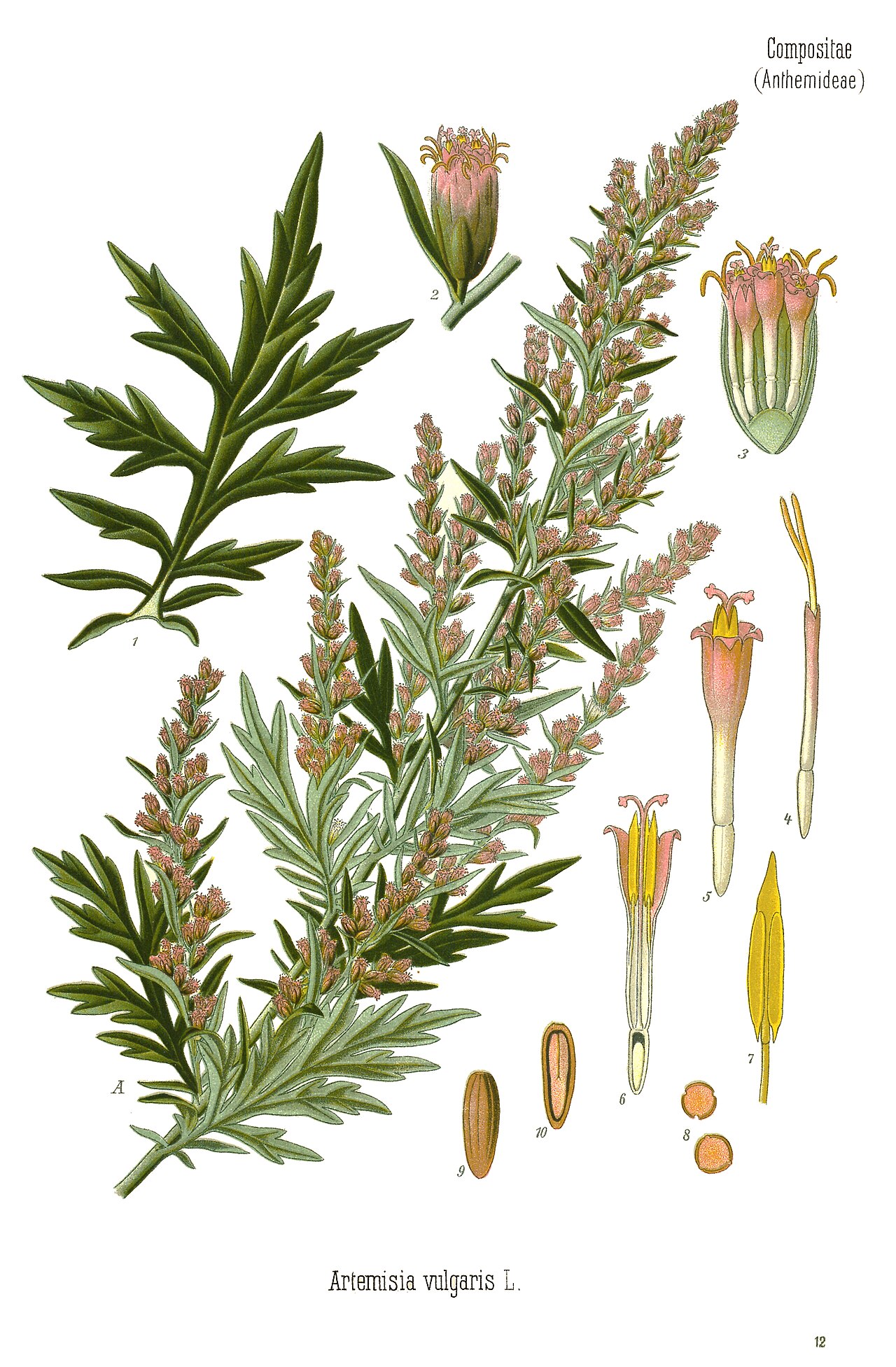
Mugwort (Artemisia vulgaris) has a distinct midsummer role documented from the sixteenth century. Rembert Dodoens, in his 1554 Flemish herbal Cruydeboeck, describes the practice of weaving mugwort into belts — cingulum sancti Iohannis, girdles of St. John — that were worn through the midsummer bonfire vigil and then thrown into the flames. The gesture was understood as the transfer of the wearer’s accumulated ailments and ill fortune from body to herb to fire. The custom is documented across the Low Countries, Germany, and northern France, and is substantially older than Dodoens’s record of it.
Vervain, fern, and wormwood also appear in midsummer herb lists across multiple traditions. The pattern is consistent: these are plants gathered at the moment of maximum solar energy, credited with concentrated virtue because of the season, and used for protection, purification, and healing.
Importantly, the correspondence between specific herbs and midsummer is not a modern invention layered over an empty calendar date. The mugwort belt, St. John’s Wort at the windows, the herb garlands worn into the fire — these are documented practices, sourced to named texts and datable periods.
Stonehenge, alignments, and what cannot be said
No account of midsummer can leave Stonehenge unaddressed. The monument’s principal axis aligns with the midsummer sunrise; the Heelstone marks the solstice sunrise within a degree or two. The alignment is confirmed by archaeological survey. It was clearly intentional.
Stonehenge’s main phases date to approximately 3000–1500 BCE. Its builders were not Celts, not Druids, and not Anglo-Saxons. The Druids’ association with Stonehenge is an eighteenth-century romantic invention — it entered popular culture through William Stukeley’s antiquarian writings and has proven nearly impossible to dislodge despite having no archaeological basis. Modern druids celebrating the solstice at Stonehenge are practicing a tradition that dates to 1905 at the earliest, when the Order of Druids first obtained access to the monument.
None of this makes the alignment unimportant. A consistent pattern of solar orientation across Neolithic monuments in Britain and Ireland — Stonehenge (midsummer sunrise), Newgrange (midwinter sunrise), Maeshowe (midwinter sunset), the Grange Stone Circle — establishes beyond reasonable doubt that the solstices were calendrically and ceremonially significant to the inhabitants of these islands across a span of three thousand years. The astronomical turning-point mattered. What the ceremonies were, what they were called, and how they related to the folk customs documented in the sixteenth century onward: these are not recoverable from the archaeological record.
The solstice is genuinely old. The specifics are not.
The eight-sabbat wheel and how it was built
The Wheel of the Year as most practitioners now use it is a mid-twentieth century structure. Understanding how it was built clarifies what “Litha” inherits and what it creates.
The four Gaelic fire festivals — Samhain, Imbolc, Beltane, Lughnasadh — have genuine medieval Irish documentation and plausible pre-Christian roots in the pastoral calendar. They mark transitions in the grazing and agricultural year. They are not solstice or equinox festivals; they are cross-quarter days.
The four solar festivals — winter solstice, spring equinox, summer solstice, autumn equinox — come from a different set of traditions, broadly northern European but not specifically Celtic or Gaelic.
Hutton traces in The Triumph of the Moon how Gerald Gardner and Ross Nichols combined these two systems in the 1950s. Gardner brought the fire festivals from his emerging Wiccan tradition; Nichols, founder of the Order of Bards, Ovates and Druids, favored the solar festivals. The synthesis that resulted is eclectic and deliberate — a modern construction that draws on genuine historical materials from multiple distinct traditions and assembles them into a coherent eight-fold calendar. The phrase “Wheel of the Year” was in use by the mid-1960s.
The summer solstice was part of this calendar from early in its assembly, identified simply as Midsummer. Kelly’s 1974 naming of it as Litha gave it a label that felt Anglo-Saxon in register — which fitted the broader tendency in American neopaganism to reach for historical terminology as a marker of authenticity.
Knowing this does not invalidate the wheel as a devotional structure. It clarifies its nature. Practitioners are working with a twentieth-century calendar that honors ancient seasons; the calendar is not a recovery of one ancient practice but a synthesis of several. These are different things with different implications for how the work is understood.
The Christian frame and the pre-Christian question
Midsummer is different from the Gaelic fire festivals in one important respect: its primary historical documentation runs through the Christian calendar, not alongside it or despite it. The feast of St. John the Baptist is not a thin Christian veneer painted over a preserved pagan ceremony. The saint’s day and the folk customs co-evolved across centuries of Catholic Europe. Trying to peel them apart to find a “purer” pre-Christian layer is methodologically dubious and probably futile.
This matters for practice. A practitioner who works the solstice bonfire is not secretly recovering paganism from beneath Christianity; she is working a living tradition that was explicitly Christian in form for most of its documented history. The fire, the herbs, the leap — these are authentically midsummer customs. Their cultural frame has been plural for a very long time.
Hutton is consistent on this point across his work: the Christian saints’ days and the folk seasonal customs interpenetrated each other. Midsummer observance survived the English Reformation in attenuated form, was revived and romanticized by nineteenth-century folklorists, and passed into the twentieth century in that filtered form. Modern pagan midsummer practice is, in part, the third act of a Victorian revival — itself a romantic reconstruction, now reconstructed again.
The name and the thing: what to make of both
The split between the name “Litha” and the festival’s actual roots creates two distinct questions.
The first is terminological. “Litha” is a defensible sabbat label — it has been in standard pagan use for fifty years and derives from genuine Old English vocabulary. “Midsummer” has the longer history by far; it has named the June turning-point in English since the fourteenth century, appears in Shakespeare, in church records, in folk collections, and requires no scholarly reconstruction. Either word is usable. A practitioner who prefers “Litha” for its Anglo-Saxon register should simply know she is using a 1974 coinage; a practitioner who says “Midsummer” is using the term with the deeper historical roots.
The second question is practical: which customs have real depth? The bonfire, communal if at all possible, lit on the eve of the solstice or St. John’s Eve, is the most defensible single custom in the historical record. Herb-gathering — especially St. John’s Wort and mugwort — is well-attested and practical. The overnight vigil through the short night is documented across northern Europe. The mugwort belt thrown into the fire combines the herb tradition with the fire tradition in a form specifically documented in the sixteenth century.
Modern additions — charging tools in solstice sunlight, solar deity invocations drawn from reconstructed mythology, wheel-of-the-year altar compositions with a fixed set of seasonal symbols — are largely twentieth-century developments and should be understood as such. Contemporary practice creates tradition; that is not a deficiency. But it is worth knowing when you are standing in documented custom and when you are standing in recent creation.
Working the solstice
The practical core of midsummer observance, drawn from the historical record:
The fire. The bonfire is the oldest and most consistent element. Outdoor fire on the eve of the solstice or June 23. Communal where possible — the fire as communal event, not private ceremony, runs through every European tradition. The leap or the circumambulation are documented gestures: leaping for purification and good fortune, walking around for blessing.
The herbs. St. John’s Wort gathered at or just before the feast day, hung at windows and thresholds. Mugwort woven into a garland or belt, worn through the night, and thrown into the fire at the end — the transfer of misfortune to the herb to the flame is the stated logic of the sixteenth-century custom. Vervain appears in multiple midsummer herb lists for protective use.
The dew. If the solstice falls in a period where dew is possible, the early morning of the feast day was considered especially potent across several northern European traditions. Washing in midsummer dew, or collecting it from specific plants, is documented in folk medical records.
The vigil. Staying awake through the short summer night, watching for the solstice sunrise, appears across traditions. It requires no elaborate ritual framing to be meaningful.
What this looks like on an altar, what deity framework surrounds it, how it is liturgically organized — these are decisions every practitioner or tradition makes. The historical record supplies the structural elements; the contemporary practice fills in the rest. Both parts of that formulation deserve to be named accurately.
Cross-references on this site
Mugwort correspondence — the full account of the cingulum tradition and the herb’s midsummer lineage. Samhain and the Gaelic fire festivals — how the other half of the eight-sabbat wheel is sourced. The Lacnunga in context — Bede and Anglo-Saxon folk medicine. Beltane history — the parallel structure of a fire festival with genuine medieval roots. (All forthcoming.)
Sources
- 1 Bede (Beda Venerabilis) , De Temporum Ratione (The Reckoning of Time) (725) Chapter 15, De mensibus Anglorum — the primary source for the Anglo-Saxon month names Ærra Līþa and Æftera Līþa, and for Bede's gloss of liða as 'calm' or 'navigable.'
- 2 Ronald Hutton , Stations of the Sun: A History of the Ritual Year in Britain (1996) The standard scholarly account of British calendar customs; covers midsummer bonfires and St. John's Eve practices in documentary depth.
- 3 Ronald Hutton , The Triumph of the Moon: A History of Modern Pagan Witchcraft (1999) Traces the assembly of the eight-sabbat Wheel of the Year in the twentieth century.
- 4 J. G. Frazer , The Golden Bough (1922) Chapter 62 catalogs midsummer fire-festivals across Europe. Use for the breadth of the custom record, not for Frazer's solar-mythology interpretive framework.
- 5 Aidan Kelly , About Naming Ostara, Litha, and Mabon (2017) Kelly's own account of coining the three sabbat names in 1974, including his reasoning from the Bede calendar by analogy with Yule.
- 6 Rembert Dodoens , Cruydeboeck (1554) Flemish herbal documenting the midsummer mugwort belt (cingulum) tradition in the Low Countries.